Delivered by:
Carbon Trust and Transforma
Supported by: Coal Asset Transition Accelerator (CATA)
Beneficiary: Confidential
Country: Colombia
Summary
Achieving Colombia’s climate targets demands an accelerated and strategic decarbonisation of its power sector. With energy contributing approximately 30% of national greenhouse gas emissions – 24% of which stem from coal-fired power generation (IDEAM, 2024) – the imperative to phase out coal is clear. A decisive shift toward renewable energy is not only critical for reducing emissions but also central to securing a resilient, low-carbon energy future for the country.
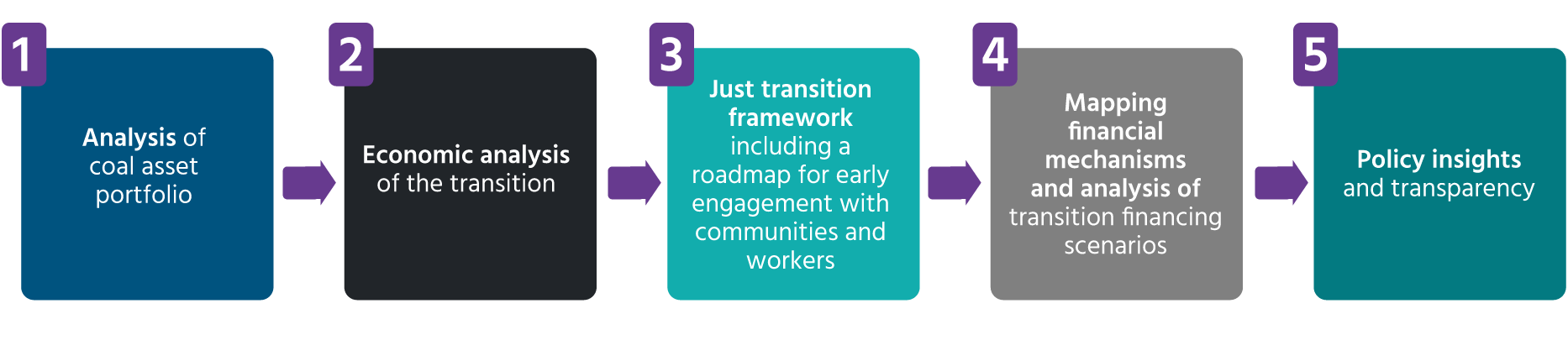
In 2023, the Colombian government took a significant step toward power sector decarbonisation by announcing that a state-owned company operating two major coal plants would fully repower one of its facilities. With technical support from the Coal Asset Transition Accelerator (CATA), the Carbon Trust and Transforma collaborated to develop a robust decarbonisation strategy for the company. This strategy followed a structured five-step methodology: comprehensive coal portfolio analysis, economic feasibility assessment, design of a Just Transition (JT) framework, evaluation of financing mechanisms, and generation of policy insights to inform national planning and implementation.
CATA’s role – Support provided
CATA, in partnership with the Carbon Trust and Transforma, supported the company in developing and implementing a comprehensive company-wide decarbonisation strategy underpinned by a JT approach. The strategy encompassed the transition of two assets, Plant 1 and Plant 2, and provided information to facilitate decision-making. The specific objectives set for developing the strategy included:
- Support and accelerate the transition from coal to renewable energy sources for Plant 1 and Plant 2.
- Identify mitigation actions for the social and economic risks and impacts on affected communities under a JT framework.
- Map potential financial mechanisms to support the transition.
- Provide insights for relevant policy makers related to coal transition challenges at the plant level.
Approach
The project was delivered through five structured work packages, each addressing a critical dimension of coal transition planning. These included: a comprehensive coal asset portfolio analysis (WP1); an economic feasibility assessment for transition options (WP2); development of a JT framework to guide engagement with workers and communities (WP3); evaluation of financial mechanisms and alternative financing scenarios (WP4); and generation of policy insights to ensure transparency and inclusivity throughout the process (WP5). Work Packages 1 and 3 were applied to both plants, while WP2 and WP4 focused exclusively on Plant 2. WP5 addressed broader transition considerations at both the national and asset levels.
- For Plant 1, pre-feasibility studies had already been conducted by a third-party organisation. The project built on these findings to assess options including solar PV, natural gas conversion, and hydrogen transition. A JT framework was developed to assess impacts on workers and communities, and financial mechanisms were mapped to support the transition.
- For Plant 2, the team carried out detailed financial modelling and JT activities in addition to developing and assessing 15 transition scenarios, including consideration of enhanced geothermal, solar photovoltaic, flexible operation, and small modular reactor options. These were evaluated using a Red-Amber-Green (RAG) analysis and a Multi-Criteria Analysis (MCA) across technical, financial, environmental, and social indicators.
Key findings
- Plant 1: Recommended route – Solar PV:
- Has strong environmental and social benefits despite financial challenges.
- Operational costs could be reduced by 99% due to zero fuel costs.
- Eliminates carbon emissions and air pollution entirely.
- Existing infrastructure can be reused; however additional land and equipment is needed.
- Only 7% of the workforce could be retained, but short-term construction jobs would be created.
- There is significant reduction in land degradation and improved environmental outcomes.
- Plant 2: Recommended route – Enhanced Geothermal:
- Was the highest scoring option across technical, financial, environmental, and social criteria in comparison to prefeasibility studies carried out for Solar PV, Synchronous condenser, biomass co-firing and run flexibly.
- Has potential to reuse existing infrastructure and deliver a 344 GWh annual energy surplus.
- There is a projected 24% reduction in operational costs and 15% increase in revenue.
- Minimal emissions and air pollution; however, drilling impacts require further assessment.
- Up to 57% of workforce could be retained and retrained, with additional jobs created during construction.
- Enhanced geothermal as an option could reduce emissions by 2.9 million tonnes of CO₂ annually.
- Plant 2 technology is in a phase of maturation and focussed on cost reduction. Despite having a conservative CAPEX projection, enhanced geothermal is a viable alternative that will see deployment expand.
- Strategic transition benefits:
- Clean energy transition offers long-term cost savings, energy security, and climate resilience. Opportunities include lower operational costs, enhanced competitiveness, and resilience to climate risks (e.g., carbon pricing). However, challenges, such as high upfront investment, policy uncertainty, and potential short-term electricity price increases, remain.
- System-wide planning is needed to ensure grid stability and ancillary service provision.
- Financial Mechanisms:
- Blended and concessional finance is essential for viability.
- Carbon pricing, debt structure, and early mobilisation of Coal Transition Mechanisms (CTMs) improve bankability and reduce capital costs.
- JT Imperatives:
- Social equity must be embedded in transition planning and workforce retention through retraining is critical. In this project, early engagement was essential to accurately assess the impacts of the transition across the value chain, including direct, indirect, and induced employment, and to fully understand how workers and livelihoods would be affected.
- Carbon pricing potential:
- Carbon pricing can incentivise early coal retirement, improve energy efficiency, and unlock sustainable finance.
Impact and Next Steps
- Project Impact:
- This project delivered a replicable model for coal transition planning in Colombia.
- It also demonstrated that early retirement and repurposing can be technically feasible, financially viable, and socially just when backed by robust analysis and stakeholder engagement.
- Next Steps – Plant 1:
- Advance JT activities.
- Engage with workers and unions.
- Finalise retirement and retraining strategies.
- Next Steps – Plant 2:
- Conduct detailed feasibility studies for enhanced geothermal conversion.
- Develop a Coal Transition Mechanism (CTM) strategy.
- Secure concessional finance or grant funding to de-risk investment.
- Cross-Cutting Actions:
- Engage with financiers, the Ministry of Finance, and the company board to determine optimal financing structures.
- Progress a portfolio of renewable energy projects to enable early coal retirement.
- Continue JT planning with tailored support measures for workers and communities.
- Maintain early engagement to identify retraining opportunities and alternative livelihoods.
Lessons Learned
- Early and inclusive engagement with stakeholders was essential to build trust and identify socially acceptable transition pathways.
- The partnership between Carbon Trust and Transforma combined technical expertise with local insight, ensuring strong ownership and credibility.
- The use of RAG and MCA methodologies allowed for tailored, site-specific analysis and can be replicated across other coal assets in Colombia and Latin America.
- This case study serves as a flagship example of how to plan and execute coal retirement in a technically robust, socially just, and financially sound manner.
Contact
Interested in supporting the coal transition? Get in touch.